Introduction
On-page SEO is one of the most critical factors in improving search engine rankings for any WordPress website. While many website owners install SEO plugins like Rank Math or Yoast, simply installing a plugin does not guarantee high optimization scores.
Achieving a 90+ on-page SEO score requires structured implementation, proper keyword placement, clean metadata, internal linking, schema markup, and technical refinement.
In this guide, we will break down the exact process required to properly optimize a WordPress page for strong on-page SEO performance.
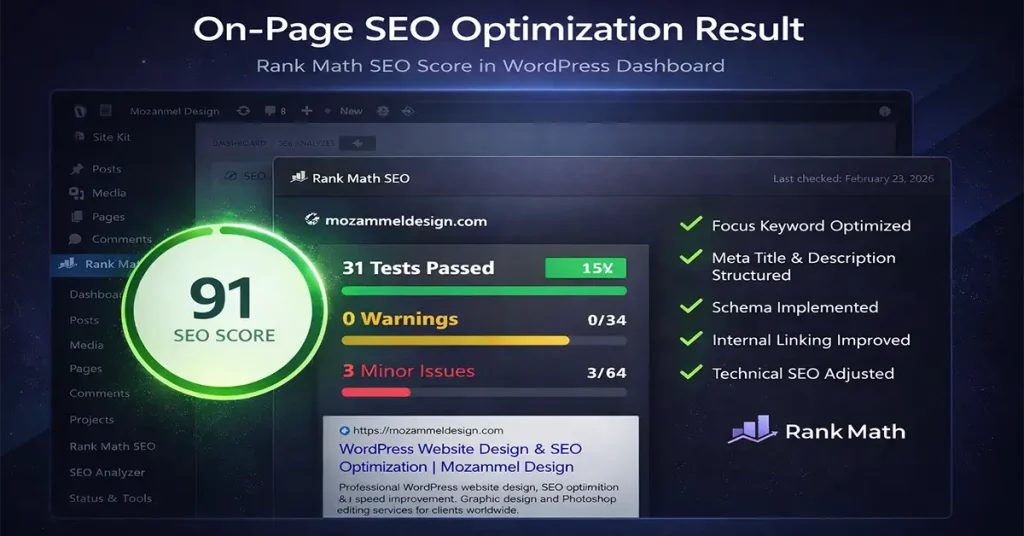
Example of a properly optimized WordPress page achieving a 90+ on-page SEO score.
What Does a 90+ On-Page SEO Score Actually Mean?
A high SEO score indicates that the page has:
- Proper focus keyword integration
- Optimized meta title and description
- Clean URL structure
- Logical heading hierarchy
- Internal linking structure
- Image alt text optimization
- Schema markup implementation
- Basic technical SEO checks completed
However, the goal is not just the number — but structured optimization that supports search visibility.
Step-by-Step Process to Improve On-Page SEO in WordPress
1. Focus Keyword Placement
Your focus keyword should appear naturally in:
- The SEO title
- The first paragraph
- At least one subheading (H2 or H3)
- The URL slug
- Image alt text (where relevant)
Avoid keyword stuffing. Keep it natural and readable.
2. Optimize Meta Title & Description
Your meta title should:
- Contain the focus keyword
- Be under 60 characters
- Be compelling and clear
Your meta description should:
- Stay under 160 characters
- Clearly summarize the page
- Encourage clicks from search results
3. Proper Heading Structure (H1–H6)
Use only one H1 per page.
Break sections into logical H2 and H3 subheadings.
Search engines rely heavily on clean heading structure to understand content hierarchy.
4. Improve Internal Linking
Internal links help:
- Distribute authority
- Improve crawlability
- Increase time on site
Each page should link to relevant internal content naturally.
5. Image Optimization
For every image:
- Add descriptive alt text
- Compress image size
- Use proper file naming
Optimized images contribute to both SEO and page speed.
6. Implement Schema Markup
Schema helps search engines better understand your content.
For blog posts, use:
- Article schema
- FAQ schema (if applicable)
- Breadcrumb schema
Most WordPress SEO plugins support schema implementation.
7. Technical SEO Checks
Before publishing, verify:
- No broken links
- Clean permalink structure
- Mobile responsiveness
- Fast page loading speed
- No duplicate content
Technical SEO strengthens overall page performance.
Common Mistakes That Lower SEO Scores
- Keyword stuffing
- Missing meta descriptions
- No internal links
- Ignoring mobile optimization
- Large uncompressed images
- Duplicate headings
Avoiding these mistakes alone can significantly improve optimization scores.
Final Thoughts
Achieving a 90+ on-page SEO score is not about manipulating a plugin — it is about implementing structured optimization practices correctly. When done properly, strong on-page SEO supports better indexing, improved visibility, and long-term search performance.